
CEnT-S Reasoning on Texts and Data: Why Is It Important?
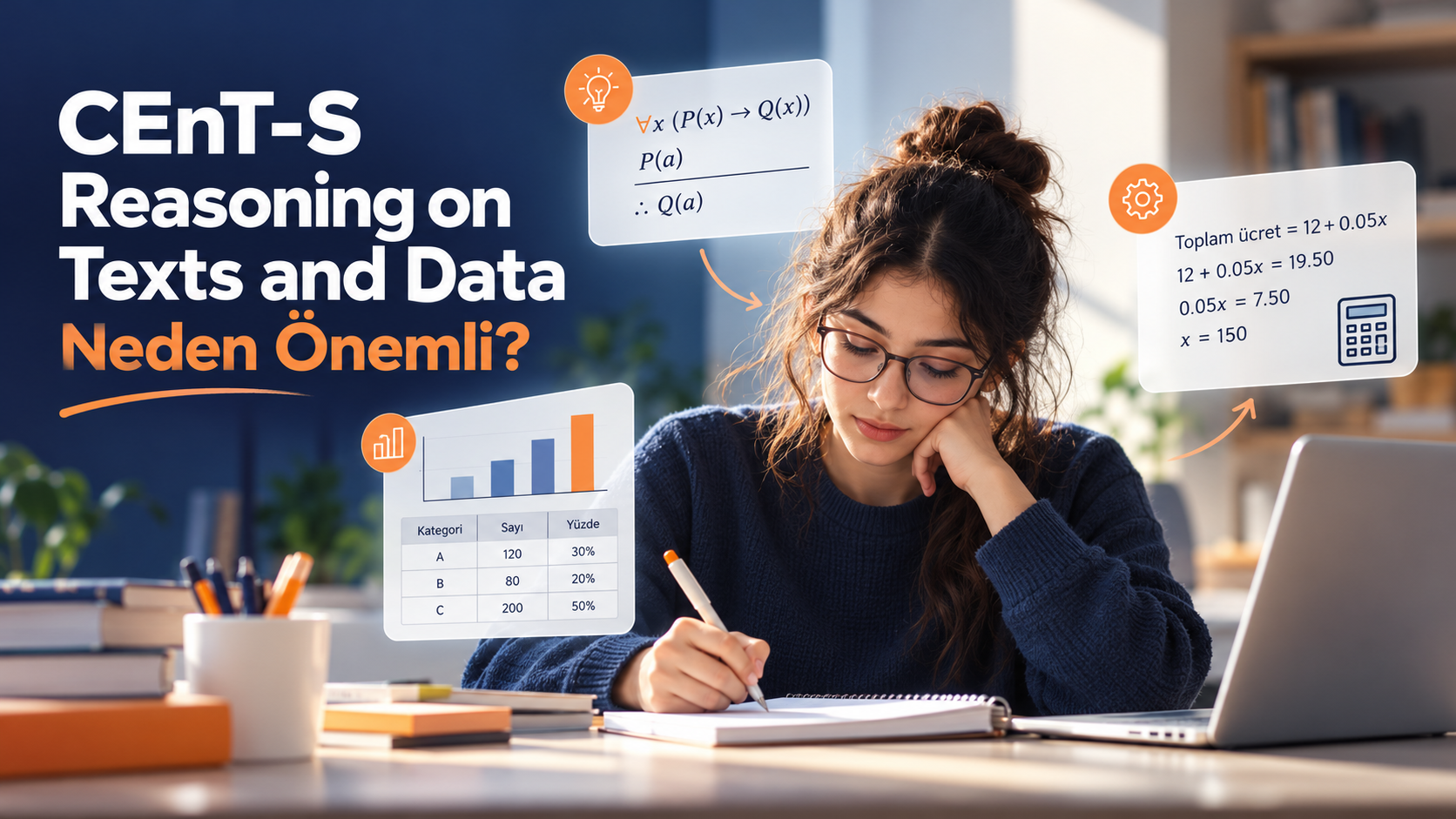
In the CEnT-S exam, knowing Mathematics, Physics, Chemistry, or Biology is not enough on its own. Candidates are also expected to interpret information correctly, identify logical relationships between statements, and draw valid conclusions from texts, tables, and graphs. Yapıştırılan metin
These skills are assessed directly in the Reasoning on Texts and Data section.
In the current CEnT-S format, this section:
contains 15 questions,
lasts 30 minutes,
is one of the exam’s 6 sections,
uses 5-option multiple-choice questions with one correct answer. Yapıştırılan metin
The Reasoning on Texts and Data section is not simply a traditional “logic” section. According to the official CISIA syllabus, it is divided into three main areas:
Logic and Deductive Reasoning
Interpretation and Manipulation of Data
Problem Solving and Basic Mathematical Language Yapıştırılan metin
This means students need to do more than perform calculations. They must understand what they read, follow conditions carefully, connect pieces of information, and determine which conclusions are actually supported by the information given.
What Are the Main Topics in CEnT-S Reasoning on Texts and Data?
1. Logic and Deductive Reasoning
In this area, candidates are expected to understand logical relationships between statements and draw valid conclusions from the information provided.
Important skills include:
understanding logical connections such as negation, conjunction, disjunction, and implication,
interpreting words such as every, all, each, none, at least correctly,
determining whether statements are compatible or contradictory,
drawing conclusions from given premises,
identifying a counterexample that disproves a statement,
distinguishing between necessary conditions and sufficient conditions,
reasoning with sets and different forms of representation. Yapıştırılan metin
One of the most important skills here is reading statements according to their logical meaning, not according to everyday intuition.
For example:
Every student who passed Physics also passed Mathematics.
This tells us that every student who passed Physics also passed Mathematics.
However, it does not allow us to conclude that:
Every student who passed Mathematics also passed Physics.
That would reverse the direction of the original statement.
Every applicant who received a scholarship scored at least 80 points. Which observation would prove this statement false?
2. Interpretation and Manipulation of Data
In this part of the exam, students are expected not only to read tables and graphs, but also to interpret and transform the information they contain.
Candidates may need to:
extract numerical information from texts, tables, and graphs,
interpret histograms, pie charts, and line graphs,
draw conclusions from datasets,
determine whether a claim is supported by the available data,
apply different ranking or ordering criteria,
decide which calculation is needed to obtain a requested result. Yapıştırılan metin
The mathematics involved may sometimes be simple. The real difficulty is often deciding which information should be used and how it should be interpreted.
Example;
At a store:
200 customers visited on Monday, and 15% of them made a purchase.
300 customers visited on Tuesday, and 20% of them made a purchase.
What percentage of all customers across the two days made a purchase?
Monday:
200 × 0.15 = 30
Tuesday:
300 × 0.20 = 60
Total customers who made a purchase:
90
Total customers:
500
Therefore:
90 / 500 × 100 = 18%
The calculation itself is not difficult. However, simply averaging 15% and 20% to get 17.5% would be incorrect because the two groups are not the same size. Yapıştırılan metin
This type of question shows the main logic of the section: read the data correctly, choose the right operation, and interpret the result properly.
3. Problem Solving and Basic Mathematical Language
This is the part of Reasoning on Texts and Data that is closest to mathematical thinking.
However, the goal is not to test advanced mathematics.
Candidates may be expected to:
understand information presented in text, figures, tables, or diagrams,
represent a problem using tables, diagrams, sets, or schemas,
calculate or estimate simple numerical results,
compare and order numbers,
use percentages, ratios, proportions, and arithmetic means,
translate a verbal relationship into an equation,
extract information from a formula,
judge whether a mathematical answer makes sense in the context of the problem. Yapıştırılan metin
The equation itself may be simple. The harder part is often building the correct mathematical model from the text.
Example;
A phone plan costs €12 per month and includes 100 minutes.
Each additional minute beyond the included 100 minutes costs €0.05.
Marco paid €19.50 in total. How many minutes did he use?
Additional cost:
€19.50 − €12 = €7.50
Additional minutes:
€7.50 / €0.05 = 150
Including the 100 minutes in the plan:
150 + 100 = 250 minutes
Correct answer: 250
The arithmetic is straightforward, but the candidate must first identify which part of the total cost represents the additional usage charge. Yapıştırılan metin
Why Is Reasoning on Texts and Data Important?
This section is different from many of the other CEnT-S sections.
In Mathematics, knowing a formula can directly help you solve a question. In Biology or Chemistry, knowing a concept can be decisive. In Reasoning on Texts and Data, however, success often depends on how carefully you interpret the information given in the question. Yapıştırılan metin
Important skills include:
following all conditions correctly,
separating relevant information from irrelevant information,
noticing words such as always, at least, only, every, none,
reading graphs and tables quickly,
interpreting percentages and ratios correctly,
checking whether a statement is truly supported by the data,
estimating results and eliminating clearly unreasonable answer choices.
For this reason, the section measures not only knowledge but also systematic reasoning and disciplined problem solving.
What Is the Difference Between Mathematics and Reasoning on Texts and Data?
There is some overlap between the two sections.
Both may involve:
percentages,
ratios,
proportions,
arithmetic mean,
equations,
tables and graphs. Yapıştırılan metin
However, the way these skills are tested is different.
Mathematics | Reasoning on Texts and Data |
|---|---|
Mathematical concepts are more central. | Interpretation of information is more central. |
The equation or mathematical structure may be given directly. | The equation often has to be built from the text. |
Calculations and mathematical properties are more important. | Relationships between conditions and information are more important. |
The goal is often to find a mathematical result. | The meaning of the result in context also matters. |
Being strong in Mathematics does not automatically guarantee a high score in Reasoning on Texts and Data. Yapıştırılan metin
What Should You Pay Attention to in CEnT-S Reasoning Questions?
Do not overlook words such as “every”, “some”, “none”, and “at least”
A single word can completely change the meaning of the question.
For example:
At least 20 students
does not mean exactly 20 students.
It means:
20 or more students.
Do not confuse necessary and sufficient conditions
A condition being necessary does not mean it is sufficient on its own.
For example:
Being at least 18 years old is necessary to apply.
This does not mean:
Everyone who is at least 18 years old can apply.
There may be other requirements as well. Yapıştırılan metin
Do not assume every relationship in a graph is causal
Two variables may increase together, but this does not automatically mean one causes the other.
If the question asks what can be concluded from the data, avoid making a claim that is stronger than the evidence allows. Yapıştırılan metin
Do not average percentages automatically
If two groups have different sizes, you may need to calculate the actual quantities first before finding the combined percentage. Yapıştırılan metin
Check whether the result makes sense in the real-world context
A mathematical answer may not always be the final practical answer.
For example, if a calculation shows that 3.4 buses are required, the real answer may need to be 4 buses. Yapıştırılan metin
How Should You Prepare for the CEnT-S Reasoning on Texts and Data Section?
Studying theory alone is not enough for this section.
A practical three-stage approach is more effective:
First, learn the core concepts.
Make sure you understand logical statements, necessary and sufficient conditions, percentages, ratios, averages, and basic graph interpretation.
Then, practise each question type separately.
Logic questions, data interpretation questions, and problem-solving questions require slightly different reasoning processes.
Finally, move to timed mixed practice.
The current section gives you 30 minutes for 15 questions, which is an average of about 2 minutes per question. Instead of forcing yourself to spend exactly two minutes on every question, it is usually better to complete easier questions quickly and save more time for questions that require deeper reasoning. Yapıştırılan metin
Is the Turkish High School Curriculum Enough for This Section?
Partly.
The Turkish high school curriculum provides a useful foundation in areas such as:
percentages,
ratios and proportions,
arithmetic mean,
basic equation building,
interpretation of tables and graphs. Yapıştırılan metin
However, CEnT-S Reasoning on Texts and Data often places these skills inside an English-language reasoning context.
Students may also need additional practice with:
propositions,
logical consequence,
necessary and sufficient conditions,
counterexamples,
compatibility of statements. Yapıştırılan metin
For this reason, solving only Turkish high school mathematics questions is not enough. Candidates should also become familiar with English reasoning questions written in the CEnT-S style.
Frequently Asked Questions About CEnT-S Reasoning on Texts and Data
How many questions are there in the Reasoning on Texts and Data section?
The current CEnT-S format includes 15 questions in 30 minutes. Yapıştırılan metin
Is this section only about logic?
No. It includes three main areas:
Logic and Deductive Reasoning
Interpretation and Manipulation of Data
Problem Solving and Basic Mathematical Language Yapıştırılan metin
Do I need advanced mathematics?
No. Basic mathematical language is more important than advanced mathematics. You should be comfortable with percentages, ratios, proportions, averages, basic calculations, and simple algebraic modelling. Yapıştırılan metin
Are there graph and table questions?
Yes. The section may include different forms of data representation such as tables, histograms, pie charts, and line graphs. Yapıştırılan metin
Which topics are important in the logic part?
Important areas include logical connectives, quantifiers, propositions, counterexamples, necessary and sufficient conditions, and deductive reasoning. Yapıştırılan metin
Can unused time be transferred between sections?
No. Each CEnT-S section has its own time limit. Once you move to the next section, unused time cannot be transferred and you cannot return to the previous section. Yapıştırılan metin
In Short
Success in CEnT-S Reasoning on Texts and Data depends on developing three skills together:
Logical Reasoning + Data Interpretation + Problem Solving
The mathematics used in this section is often not advanced. What makes the difference is the ability to read carefully, interpret conditions correctly, select the relevant information, and determine what can actually be concluded from the data. Yapıştırılan metin
For this reason, preparation should include not only topic study but also regular practice with CEnT-S-style reasoning questions under the 15-question / 30-minute format.